Showing posts with label rejection. Show all posts

Wednesday, September 14, 2011

Wondering

"Have you ever wondered ...

How could he disappear after he was so totally into me? Why hasn’t he texted? Why does he pull away every time we get close? Was it just about the sex? How could he not be interested in me? Why doesn’t he make a move? Will he ever commit? What the bleep is going on in this relationship? Is it him or is it me?

Ah, men. Mystifying men.

And we’re supposed to be the mysterious ones! Truth is, men are at least as hard to figure out as women. Their behavior can be confusing, frustrating and maddening. They tease us with clever poems, daily texts and calls, only to turn around in the blink of an eye and completely disappear or disappoint us. Who hasn’t fallen for that grand opening game, where they lure us with intoxicating conversations, exciting fun-filled dates, a single perfect rose, delicious kisses and more?" (excerpt from Aha! Understanding the mind games men play by Psychologist Diana Kirschner unveils mysteries of ‘deadly dating patterns’)

So let me say that I have not read (nor do I intend to read) this woman's book "Love in 90 days". However, being that I'm going through a particularly frustrating (see also sad, depressed, angry, and confused) time I have been trolling for advice, words-of-wisdom and/or common experiences online. 

I have spent years falling too hard, too fast, for men who are all words. Finally met a man I feel madly in love with, and then spent two years waiting for him to step up and act on his words. 

When I finally said enough was enough did I go and find myself someone the exact opposite of what I had found in the past? 

No, of course not. I found myself Mr. CT. A man who made me weak in the knees, gave me butterflies in my stomach, sweet talked me into believing we had a special connection and then *poof* GONE. No words of "it's not working out" or "I just don't feel a spark". Just gone.

I'm tired of being told I'm the girl you bring home to mom but then never is. I'm tired of being told you think I'm beautiful but then left to feel like a leper. I'm tired of watching family and friends pairing up and procreating only to then look at me with sad eyes and be told "don't worry, it'll happen for you".  Tired of games and being told men are just "scared of commitment". Tired of men who are just talk, or just looking to get me into bed, or just looking to stroke their own ego. Tired of feeling I've done something wrong to push them away. Tired of feeling like I'm intentionally picking emotionally obtuse men. Tired of feeling like I'm not tall enough, pretty enough, smart enough, interesting enough. Tired of allowing these thoughts in my head. I'm tired of all the bull shit.
*Deep Breath* 

Okay....obviously needed to get that out... Truth is I am just tired of it all.

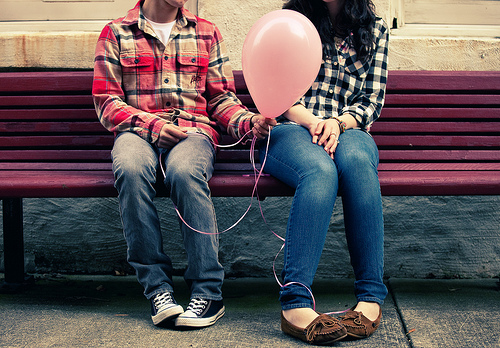
I came across this photo (-->) on Pinterest and I knew it rang true. I don't think I'm trying to force "love" with anyone but I definitely am a romantic in my core and can't help falling sometimes for a sweet smile and sweet words. I just wish that I'd stop falling for men who can just easily toss me aside like last nights leftovers.

Wednesday, July 27, 2011

Patterns.

As you know, I rejoined the dating world recently....as for when I became "single" again that's up for debate...but the point is I hoped back on the dating wagon.   And I'm wondering has anyone ever found themselves repeating a dating pattern?

I'm not talking about always dating brunettes or people with blue eyes; I'm talking about patterns of behavior, of choice, and of consequences. 

CBS News had a segment back in 09 about "Breaking Your Disastrous Dating Patterns" with Dr. Diana Kirschner, author of "Love in 90 Days: The Essential Guide to Finding Your Own True Love," and the they list the "Most Common Deadly Dating Patterns"(why is the news always so over dramatic?).  Of these "Deadly Dating Patterns" I suppose I fall into all four....

"Every woman falls into terrible patterns, Kirschner observes, adding that, if any woman looks at past relationships, she would fall into one or more of these categories: "The Hermit," "The Flameout," the "I Will Make You Love Me," and the "Not Perfect, I Will Pass."....well now, I do not believe that every woman falls into terrible patterns.I do believe that lately I'm starting to see patterns in my own dating.

Not necessarily "bad" patterns...unless I think too long on it and then I see them as self-destructive and they take on the form of giant brick walls guarding me...keeping me from being "really" hurt (whatever the hell that means). 

They're possibly patterns of avoidance, falling for men thousands of miles away, patterns of men who fall hard and quick for me as I them, patterns of falling for Mr. (Feels) Right too quick. 

I'm trying to keep my options open....not deleting my dating site account, not snubbing anyone who might email me, or those who I have been emailing with....but I have met someone. Someone who stirs things in me I haven't felt since Mr. Hong Kong and I first started dating. 

I know that these could very easily be because Mr. Connecticut is playing to my more traditional sides by asking permission to call me....Sickening sweet I know but I'm a sucker for sweet and traditional. (Also, can I just interject here that Mr. CT has called me every day for the past five days? More than Mr. Hong Kong ever did...not that I'm here to compare men/relationships)

My concern is that he's nearly 3,000 miles away. I feel that I'm developing a pattern of falling for non-local men so that I don't have to worry about the person-to-person closeness/intimacy. 

Yes, I found him on a website for people who are and prefer plus size folks....
Yes, he's expressed the fact that I am very much his type (both mentally and physically)....
Yes, he is very much my type (mentally and physically -  within the limitations of what we know about each other at this point)....but that's just my point! 

Why couldn't I find a man "my type" here in Portland? 
Why am I repulsed, time and time again,
by the men who express interest in me locally? 

Am I being too picky? 
Am I being not picky enough?


Friday, June 3, 2011

Weight = Life Burden?

So my first thought when reading this article was they need to do way more research and study various generations as well. I'm not denying that being an "over weight" teenager is hard (on both girls and boys) and that studies have shown women make less then there male counterparts. But this study is all over the place (in my opinion) - from women who are heavier are less likely to graduate college, to they are less likely to be hired for a position (with of course fostering the stigmas and stereotypes of "fat people are lazy"), to plus size girls aren't active in sports in high school, etc. 

Maybe it's just me and my personal story not connecting AT ALL with what they're "findings" are showing. I was on the "heavier" side in HS and not only graduated HS with a 3.75 but went on to be accepted into a highly rigorous academic college program (which I finished in the normal 4 years) and then went on to a (mostly) satisfying (female dominated) career (making 15.50/hour). Thank you very much.

Like I said, an interesting read nonetheless but perhaps a bit early to publish their "findings"

*          *          *

Heavy in School, Burdened for Life
By Christy M Glass, Steven A Haas and Eric N Reither
Published: June 2, 2011

MUCH of the debate about the nation’s obesity epidemic has focused, not surprisingly, on food: labeling requirements, taxes on sugary beverages and snacks, junk food advertisements aimed at children and the nutritional quality of school lunches.

But obesity affects not only health but also economic outcomes: overweight people have less success in the job market and make less money over the course of their careers than slimmer people. The problem is particularly acute for overweight women, because they are significantly less likely to complete college.

We arrived at this conclusion after examining data from a project that tracks more than 10,000 people who graduated from Wisconsin high schools in 1957. From career entry to retirement, overweight men experienced no barriers to getting hired and promoted. But heavier women worked in jobs that had lower earnings and social status and required less education than their thinner female peers.

At first glance this difference might appear to reflect bias on the part of employers, and male supervisors in particular. After all, studies find that employers tend to view overweight workers as less capable, less hard-working and lacking in self-control.

But the real reason was that overweight women were less likely to earn college degrees — regardless of their ability, professional goals or socioeconomic status. In other words, it didn’t matter how talented or ambitious they were, or how well they had done in high school. Nor did it matter whether their parents were rich or poor, well educated or high school dropouts.

Our study, published last year in the journal Social Forces, was the first to show that decreased education was the key mechanism that reduced the career achievement of overweight women — an impact that persisted even among those who lost weight later in life. We found no similar gap in educational attainment for overweight men.

Why doesn’t body size affect men’s attainment as much as women’s? One explanation is that overweight girls are more stigmatized and isolated in high school compared with overweight boys. Other studies have shown that body size is one of the primary ways Americans judge female — but not male — attractiveness. We also know that the social stigma associated with obesity is strongest during adolescence. So perhaps teachers and peers judge overweight girls more harshly. In addition, evidence suggests that, relative to overweight girls, overweight boys are more active in extracurricular activities, like sports, which may lead to stronger friendships and social ties. (Of course our study followed a particular group from career entry to retirement, and more study is needed to determine whether overweight girls finishing high school today face the same barriers, though these social factors suggest they do.)

That overweight women continue to trail men — including overweight men — in educational attainment in America is remarkable, given that women in general are outpacing men in college completion and in earning advanced degrees.

What does this mean for policy? Previous studies have shown that overweight adolescents feel stigmatized by their peers and their teachers, have fewer friends and often feel socially isolated. Teenagers who feel less connected to teachers, school and peers are less likely to graduate and go on to college. So policies to help overweight girls need to work on two levels: promoting healthful behaviors and shifting attitudes.

Obesity is occurring in children at younger and younger ages, so prevention needs to start as early as primary school. While early intervention has obvious potential health benefits, it is also critical from a career perspective. In addition, overweight girls should be encouraged to participate in college preparation courses and extracurricular activities. Health education that focuses on diet and exercise but does not stigmatize overweight teenagers is critical.

Teachers and principals need to be aggressive in limiting bullying and looking for signs of depression in overweight girls. Teenage girls, regardless of body size, struggle with self-esteem and are at higher risk of depression than boys, so expanding health education to include psychological as well as physical health could help all girls. Public health campaigns should reframe the problem of obesity from one of individual failure to one of public concern.

The economic harm to overweight women is more than a series of personal troubles; it may contribute to the rising disparities between rich and poor, and it is a drain on the human capital and economic productivity of our nation.

Christy M. Glass and Eric N. Reither are associate professors of sociology at Utah State University. Steven A. Haas is an assistant professor of sociology at Arizona State University.

Monday, May 16, 2011

28 Day Challenge - Check In

So I decided instead of posting a blog every day and boring the crap out of you all with "I walked around the building."...."I ran stairs"....blah blah blah. I'd do more of a weekly check in. 

Today is Day 16 of 28.

I've entered into my Outlook calendar 3 times to get up from my desk and go take a walk around the building (not including the walking I do on my lunch break). So far it's working great. It not only gives my eyes a break from the computer screen but it gets me up and moving and keeping warm (my office building has no real heat and I've been chilly lately). 

It's nice to have a "fall-back exercise" as it were. My goal for this 28-day challenge was to develop a new healthy habit. Adding in three walks to my schedule (including a pop-up window telling me to get out and go) every work-day helps me accomplish that. Doesn't mean though I'm not trying to do other activities outside of these walks. 

Thursday we went to the pool and swam for a while.
Saturday we went to Multnomah Falls and hiked (I didn't make it to the top but mostly because I didn't want to make the family wait below for me for too long).

It's interesting some of the things I'm observing/noticing over the past few weeks (most of which I'm sure is in my head). 

First I feel more emotional than I normally am. I know that exercising is supposed to release endorphins and therefore put you in a better mood...but that's not really what I've been experiencing. I've been out on a walk and had a burst of anger come from deep in my core. This weekend I had to go home and lay in bed to cry after a ridiculous comment from my brow-wax lady. No euphoria. No smile across my face. Just anger and tears. (WTF?)

The other thing I feel is that I've not been losing weight but gaining it. Now I know this is only Day 16 and I can't expect a miracle. I'd expect more to see no change...not an increase. Like I said this could just be in my head. But pants that don't fit, shirts that feel tighter than before, looking at pictures taken of me and seeing a larger and larger double chin. 

It's frustrating. 
I'm sticking to it though.

Friday, May 13, 2011

Coming Out Fat.

A friend recently posted a link to this article called "Guys Who Like Fat Chicks" (from the Village Voice) on her facebook page. I was a little hesitant about reading it but I trust her judgement and most times agree or like the other articles she posts. 


Okay. So I'm not sure why articles always feel like they have to parallel their cause with coming out as gay....but this article doesn't linger on it for long. It is nice to see an article that addresses the "FA" and not just BBW's with pride. A little on the long side (and pretty heavy on a single interviewee) but a good read nonetheless. 

I'm always excited/interested to read articles addressing the topic of plus size (the term I prefer to identify with) people (not just women) having normal relationships. That we (and the people who find us attractive) are not freaks of nature, we're not abnormal or something to be hidden and only talked about behind closed doors.  

*     *      *

I come from a family of curvy women - not all of them are plus size, but there are few without hips, butts, breasts and other curves. 

I was destined to be a curvy lady. 

At my smallest (obviously post-puberty) I was a 14 and at my largest (a few years ago) was a size 28 (at around 280lbs). Today I'm around 260 and a size 26. 

I'm not ashamed. I'm not trying to hide my body behind muumuus and oversized sweats. 

It's true I say I "carry my weight well" because I think I do. I dress stylish and appropriate and have had people assume my weight/size was smaller than what it was in actuality. 

It's also true that I'm currently in the middle of a "28 Day Challenge" in which I'm trying to have more exercise in my daily life. I'm not doing that because I'm ashamed of how I look. I'm doing it so I can feel healthier, so I can battle the Seasonal Depression that knocks you over when living in such a grey part of the country.

*     *     *

I've had boyfriends, when I was, from one extreme of weight to another. None (that I know) of them came out as "Fat Admirers" but obviously they liked a little extra something since they were dating me. Most of them were "breast-men" and as you can see I've got them covered there. 

Even with a fair number of beaus growing up (five in the first year and a half of HS before dating my "high school sweetheart" the remaining two years) I did struggle with self esteem issues around my weight. After my HS sweetheart and I broke up I went through a depression that really took it (the wanting to date) out of me. I just didn't feel attractive or desirable. He didn't tell me I was fat, or give me an ultimatum to lose weight. We just broke up (like you do when you're in high school).

For the most part (after highschool) I just wasn't interested in dating. I did toy around with internet dating here and there. I remember one date I went on. He took me to see the (newer) Planet of the Apes. (Yippee?) I didn't even bother asking him up afterwards. I said "Thanks, have a good night" and closed the car door.

Then there was the guy in college. The rebel who drank vodka out of a 7-up bottle during our English Freshman seminar. The smooth talker who, when I was upset with him, would spout lines from cheesy romance movies (I'm talking "You complete me" level). The one who as soon as I slept with him wouldn't give me the time of day....yeah not a highlight in the Men-In-My-Life.

Then somewhere a few years ago things changed - I opened up to the idea of dating again and as a result met my sweetie. (See our love story here). 

*     *     *

I think it's wonderful that more and more people are "coming out" as appreciators and admirers of curvy/plump/heavy/plus-size women and men...let's not forget those of us who appreciate a stockier built man. 

I'm a plus size woman. I like men with meat on their bones. I like someone who enjoys going out and trying new food and doesn't expect me to eat a garden salad when there's pasta on the menu (I mean really now I'm 1/2 Italian!)

It bothers me sometimes when I see/hear friends express feelings about being unattractive. Everyone is desirable to someone. I truly believe that you just need to embrace yourself and see yourself as deserving and desirable before you can expect others too (or at least before you can expect to start noticing that others do already)

To close I just have this to say. 

If you don't understand how or why someone is attracted to me.... Just don't worry about it, no one's making you take me out in the first place.

Tuesday, April 26, 2011

Banning Barbie?

What do other people think about Barbie?

I have to make a confession here. While I understand and am right with folks that she gives a false representation to what women's bodies look like. I also just don't have the fire in my belly to get angry about it. I played with barbie growing up and maybe it was just the way I was raised but I never wished I looked like her or hated my body because it didn't.
*     *     *
Banning Barbie
By LISA BELKIN
Mattel, via Associated Press

Ah, Barbie. Fixation of generations of little girls. And their mothers — but for different reasons.

Rebecca Fitzgerald is struggling with the Barbie dilemma at the moment. Not whether she should buy her 3-year-old daughter the doll; she is quite clear that she would never do that. No, her problem is how to keep her father from showing up with one. And she is looking for advice from Motherlode.

She writes:

I was hoping to get help from you and your readers on explaining to my 60-something father why Barbie isn’t an appropriate gift for my 3-year-old daughter! I know there’s been research on the effect of Barbie on body image in kids as young as 5, but it’s surprisingly difficult to find. He’s a physician and a father of three girls raised to think they could be president — as long as they were pretty, too.

What kind of explanation would prevent him from buying makeup kits, high heels and fishnets when he thinks a busty gal in a tiny dress is a good role model for my preschooler?!

Many thanks,
Rebecca


My first thought was that Rebecca show her father the work of Galia Slayen, now a senior at Hamilton College, who has built herself one big Barbie doll. Hers is a life-sized depiction of how Barbie would look if she were “real,” and by Ms. Slayen’s calculations, poor Barbie would measure six feet in height, with a 39-inch bust, 18-inch waist and 33-inch hips. Made of chicken wire and paper maché, she was a project for National Eating Disorder Week when Ms. Slayen was still in high school. She is dressed, literally and symbolically, in the “size double zero” skirt that “used to slip off my waist when I was struggling with anorexia,” Ms. Slayen wrote in a post on The Huffington Post earlier this year. “I put it on Barbie to serve as a reminder that the way Barbie looks, the way I once looked, is not healthy and is not ‘normal.’ ”

You can see Ms. Slayen’s appearance on “The Today Show” with her mutant Barbie here:


Visit msnbc.com for breaking news, world news, and news about the economy

After Galia Slayen, I thought Rebecca might get some good advice from Peggy Orenstein, author of “Cinderella Ate My Daughter: Dispatches from the Front Lines of the New Girlie-Girl Culture” (who happens to be appearing at the 92nd Street Y in TriBeCa Tuesday night on a panel titled “Cinderella Ate My Daughter, Sponge Bob Ate My Son: The Reality of Marketing to Kids.”)

So I forwarded the note from Rebecca, and here’s what Ms. Orenstein had to say:


Dear Rebecca,

Well, first of all, as with children, you need to establish limits with grandparents in general. The grandparents’ role is to adore the grandchildren, yes, but also to respect the parents and their wishes whether or not they agree with them. So answer No. 1 is your father shouldn’t give your daughter a Barbie simply because you don’t want him to. Regardless of whether he thinks that’s foolish or wise. Anything else overrides and undermines your parental authority.

So that’s the Dear Abby part. Let’s move on to Barbie. Barbie is really a symbol of your larger concern, right? It’s not Barbie in a vacuum. And it would be simplistic to say that A+B=C; that is, that if you play with Barbie you’ll grow up to have an eating disorder. In fact, I wish it were that simple.

But what you’re battling against here is something larger and more complex — a marketing and childhood culture that encourages girls in an unprecedented way from an unprecedentedly young age to define themselves through appearance and play-sexiness, that defines femininity through materialism and narcissism. There’s a marketing notion called kids getting older younger: products are pitched initially to older children, but younger kids, wanting to be like cool older sibs, soon adopt them, at which time the older kids instantly abandon them as babyish and move on to something even “cooler.” And for girls, being cool means looking hot.

Dad sounds like a science-y guy, so lob some hard stats at him to explain: when she was first released in 1960, Barbie’s original demographic was 9- to 12-year-old girls. Now a girl is done with Barbie by 5. Fifty percent of 6- to 9-year-old girls in a survey by a market research group say they regularly wear lipstick or lip gloss, and the percentage of 8- to 12-year-olds wearing mascara and eyeliner doubled between 2008 and 2010 (why isn’t the percentage of 8-year-olds wearing mascara zero?).

I’m sure you saw the recent fracas over the push-up bikini top that Abercrombie & Fitch was trying to sell 7- to 12-year-old girls. That top is still out there; they just changed the name, not the product. The point is, the pressure on girls to define themselves from the outside-in rather than the inside-out is enormous. And confusing. And alluring — because it’s fun. For a while, anyway. I mean, makeup! Sparkles! Fashion! Who doesn’t like that? And it can be creative, but in such a well-worn, narrow way, right?

Meanwhile, a large-scale survey by Girls Inc. found that between 2000 and 2006 the percentage of elementary school girls who were worried about being thin went up far faster, and was much higher, than the percentage who worried about the quality of their school work. The percentage of the same girls who believed you had to be pretty and thin to be popular went up, too. The pressure girls expressed to be perfect (good at school and sports and pretty, popular and thin) went up. And the American Academy of Pediatrics — an organization I’m sure your dad respects — recently put out a memo to its members telling them that eating disorders were on the rise among children under 12 and they needed to be more mindful of the signs.

Beyond that, when we were children (or at least when I was) Barbie was a doll. Basta. She was not a lifestyle. There were no Barbie toothbrushes, Barbie tricycles, Barbie scooters, Barbie breakfast cereal (I don’t know if there’s really Barbie breakfast cereal, but there are now Disney Princess grapes, so there might as well be, and believe me, if you haven’t started fighting with Dad about Princess, that is coming). Do you really want your child to be subject to that kind of training: that her role in life is to advertise and consume licensed products to the hilt? Forget the girl stuff — your child does not exist to be a marketer’s land grab.

O.K. Now I’ve scared you. I’ve scared him. So what’s a mom or grandpop to do? I say, fight fun with fun. I’m wondering why your dad is so obsessed with Barbie. Because he liked watching you play with her? Because he thinks she defines cute, innocent girlness?

If it’s the former, why not suggest a present that would involve the three of you doing something, making some memory together? If it’s the latter, well, I get that. Girls are adorable when they play with Barbies or Princess. And little girls also have a developmental need to find a way to assert that they’re girls (more on why another time) in the most extreme way with whatever tools are at hand. When I was a child that mean baby dolls, strollers, doll houses. Now it’s spa makeovers for 4-year-olds.

That means, though, that countering with generic toys is really not enough. Besides, it’s hard to convince your daughter (or your father) that you’re giving her more choices by saying no all the time. So you need to offer her other ideas, playthings, books, movies, clothing that signify girl and signify fun yet broaden her idea of femininity. I have an evolving, idiosyncratic list of resources for this on my Web site (and if you have others, by all means let me know). Maybe you could suggest one of them to Dad as an alternative. If he’s looking for a doll companion, how about a groovy girl or a go-go sports girl? Or troll eBay for a Mulan doll (they’re out there; hard to find, though). You know what my daughter adores? Her Lennon Sisters paper dolls. I kid you not. Tell him that she will have so many messages beamed at her every day of her life that only a particular look and a particular body are acceptable, and you don’t want them to come on her birthday from one of the men she loves most in the world. In fact, you could just leave it at that.

Full disclosure, I’m personally harder core on other issues, so a few Barbies infiltrated our home. I just got ridiculously picky about which Barbies. No Barbie Basics No. 10. Not even those dopey fairytopia Barbies. We had Wonder Woman Barbie. Indonesian Barbie. It was ludicrous. But there was one of my (many) compromises. And then I put a dollar in the therapy fund.

But again, it’s not Barbie per se that’s the issue, it’s the whole culture coming at your daughter. Barbie is just the symbol.

And hey, maybe for her birthday you could give him a few presents: “Packaging Girlhood” by Lyn Mikel Brown and Sharon Lamb; “So Sexy So Soon” by Diane Levin and Jean Kilbourne; “Pink Brain, Blue Brain” by Lise Eliot; “Consuming Kids” by Susan Linn; and, of course, “Cinderella Ate My Daughter” …

Good luck,
Peggy

Friday, April 22, 2011

One of those Days.


It's just one of those days when I feel I barely have my head above water......


Tuesday, March 29, 2011

Article: Rejection Really Hurts

Rejection Really Hurts, Brain Scans Show
Christine Dell'Amore
National Geographic News
Published March 28, 2011

Maybe words can hurt you as much as sticks and stones: Romantic rejection, at least, causes physical pain, according to a new study of brain activity.

Past studies have shown that simulated social rejection may be connected to a network of brain regions that processes the meaning of pain but not the sensory experience itself.

Now MRI brain scans of people jilted in real life show "activation in brain areas that are actually tied to the feeling of pain," said study co-author Edward Smith, a psychologist at Columbia University in New York City.

Smith and colleagues recruited 40 participants via flyers posted around Manhattan and through Facebook and Craigslist advertisements.

All the volunteers reported going through an "unwanted romantic relationship breakup" within the past six months.

While in an MRI machine, the subjects were asked to look at photographs of their ex-partners and think about being rejected.

When they did so, the parts of their brains that manage physical pain—the secondary somatosensory cortex and the dorsal posterior insula, to be exact—lighted up, according to the study.

The study isn't a "true perfect experiment—we couldn't control who had the rejection experience and who didn't," Smith noted.

"This is true of any study that takes advantage of an activity that happened outside of the laboratory," he said.

"There's always the possibility that there's [some unknown element] about these people who were rejected that was causing the special pattern of what we're seeing."

Yet the results are striking, Smith said, especially because the team analyzed 150 other brain-scan experiments on negative emotions—fear, anxiety, anger, sadness—and found that none of these emotionally painful experiences activate the brain's physical sensory areas in the same way as an undesired breakup.

"There may be something special about rejection."

The painful-rejection study appeared this week in the Proceedings of the National Academy of Sciences.